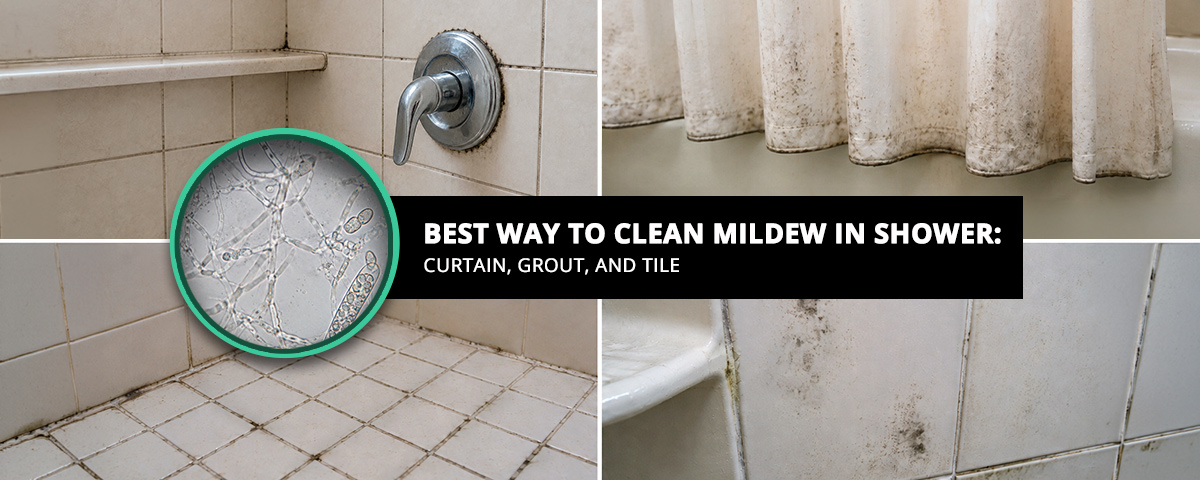
To clean mildew in a shower, apply a standard bathroom cleaner, undiluted white vinegar on non-porous tile and glass, or a baking soda paste on grout lines. Allow 10 to 15 minutes of dwell time, scrub firmly, rinse thoroughly, and dry completely. Mildew stays on the surface and responds well to lighter methods than mold when caught early.
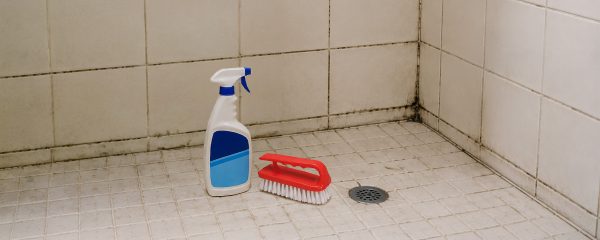
Mildew and mold are not the same problem and they do not need the same solution. If you have been reaching for the strongest cleaner you own every time you see a gray or white film in your shower, you are probably overdoing it. Mildew is a surface growth. It has not penetrated the grout or worked its way behind the caulk. That means lighter products, shorter dwell times, and a consistent drying routine are usually all you need.
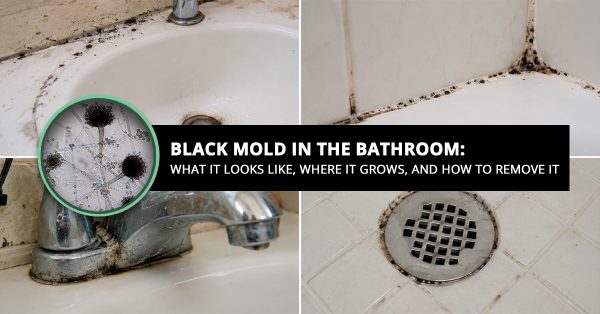
This guide covers the best way to clean mildew from every shower surface: tile, grout, curtain, and more. If what you are seeing is darker, slimier, or keeps coming back in the same spot within two weeks of cleaning, it may be mold rather than mildew. Our guide on Mold vs. Mildew in the Shower helps you tell them apart, and our guide on [Getting Rid of Shower Mold] covers the stronger approach when mildew treatment is not enough.
Key Takeaways
- Mildew is a living fungus that stays on the surface. Lighter treatment works when caught early.
- Start with the lightest effective product and escalate only if needed: standard cleaner, then vinegar, then hydrogen peroxide.
- Baking soda paste is the correct first choice for early-stage mildew in grout. No grout binder degradation risk.
- Borax solution during weekly grout cleaning slows mildew regrowth without degrading the grout binder.
- Drying completely after every shower is the single most effective mildew prevention habit.
- Mildew returning within two weeks of correct cleaning means you are likely dealing with mold.
- Pink or orange-pink growth is not mildew. It is Serratia marcescens and requires an EPA-registered disinfectant as the kill step.
Clean Mildew in Shower Overview
| SURFACE | LIGHTEST FIRST OPTION | STEP UP IF NEEDED | AVOID |
|---|---|---|---|
| Glazed tile and glass | Standard bathroom cleaner; 10 to 15 min dwell time | Undiluted white vinegar; then 3% hydrogen peroxide | Abrasive scrubbers; vinegar on natural stone |
| Cement grout (shower floor and walls)* | Baking soda paste applied directly to grout lines and scrubbed firmly with a stiff nylon toothbrush or grout brush using small circular strokes | 3% hydrogen peroxide applied directly to grout lines; at least 10 minutes dwell time keeping the surface visibly wet; scrub with stiff nylon toothbrush; rinse and dry completely | Extended hydrogen peroxide contact beyond 15 minutes on colored or unsealed grout; repeated vinegar use on cement grout |
| Shower curtain (plastic or vinyl) | Undiluted white vinegar wiped onto surface with a soft cloth; allow 10 to 15 minutes dwell time; wipe and hang fully extended to dry | Machine wash on cold gentle cycle only if care label allows; use regular detergent and vinegar in rinse cycle | Undiluted bleach with prolonged contact; hot water which can warp or damage plastic; machine washing without checking care label first |
| Shower curtain (fabric) | Machine wash per care label with detergent and vinegar in rinse cycle | Laundry disinfectant if growth is heavy or recurring | Undiluted bleach on colored fabric; hot wash if care label prohibits |
| Fixtures and faucet base | Standard bathroom cleaner wiped with a soft cloth | Undiluted white vinegar with 10 to 15 min dwell | Bleach on chrome or metal finishes |
| Shower ceiling (painted) | Undiluted 3% Hydrogen Peroxide applied with a cloth | Standard bathroom cleaner if growth is very light | Direct spray application; bleach |
Mildew is generally DIY-effective on all surfaces listed when caught early and treated promptly. If you are not sure whether you are dealing with mold or mildew, our guide on Mold vs. Mildew in the Shower helps you tell them apart.
*For bathroom floor grout specifically, pre-rinse with warm water before applying any cleaner to remove foot traffic residue that reduces cleaning effectiveness. The scrubbing tool matters as much as the product. A stiff nylon toothbrush working in small circular strokes along the grout line is required for both baking soda paste and hydrogen peroxide to be effective.
Disclaimer: Cleaning Safety and Product Guidelines Before You Start
These guidelines apply to every cleaning method in this article. Mildew generally responds to lighter treatment than mold, but the same safety rules apply regardless of which product you use. Read them before using any product on any bathroom surface and apply them at your own risk.
Use bleach, vinegar, and hydrogen peroxide occasionally, not as regular cleaners.
Repeated use of bleach, vinegar, and hydrogen peroxide on grout and porous surfaces causes cumulative damage over time. These products are appropriate for occasional mold and mildew treatment, not routine weekly cleaning.
Always follow the manufacturer’s instructions.
Contact times, dilution ratios, and surface compatibility vary by product. The label is the authoritative source, not general guidelines.
Always test on a hidden area first.
Materials vary. A product that works safely on one surface can discolor, etch, or degrade another. Apply any cleaner to a small hidden area and wait 24 hours before using it on a visible surface.
Never mix cleaning products; use only one cleaning product at a time.
Never mix bleach with vinegar, hydrogen peroxide, ammonia, or any other cleaner. These combinations produce fumes that are harmful when inhaled.
- Bleach + hydrogen peroxide: can cause rapid release of oxygen gas, which may create vigorous bubbling, splashing, and pressure in a closed container
- Bleach + vinegar: can release toxic chlorine gas
- Bleach + ammonia: can release toxic chloramine gas
- Vinegar + hydrogen peroxide combined in the same container: can form peracetic acid, a corrosive chemical that can irritate or injure the eyes, skin, and respiratory tract
For stubborn mold or growth that keeps coming back, contact a certified professional.
If cleaning does not resolve the problem or the same spot returns within two weeks, the issue has gone deeper than surface cleaning can reach.
Best Way To Clean Mildew In Shower
The best way to clean mildew in a shower is to apply undiluted white vinegar to non-porous surfaces like glazed tile and glass, allow 10 to 615 minutes of dwell time, scrub with a stiff nylon toothbrush or non-abrasive scrub brush, rinse thoroughly, and dry completely. For mildew discoloration in grout lines, 3% hydrogen peroxide with about a 10-minute dwell time and a stiff nylon toothbrush is the stronger option. Both work well on early-stage surface mildew when caught before moisture and residue allow deeper mold growth to develop.
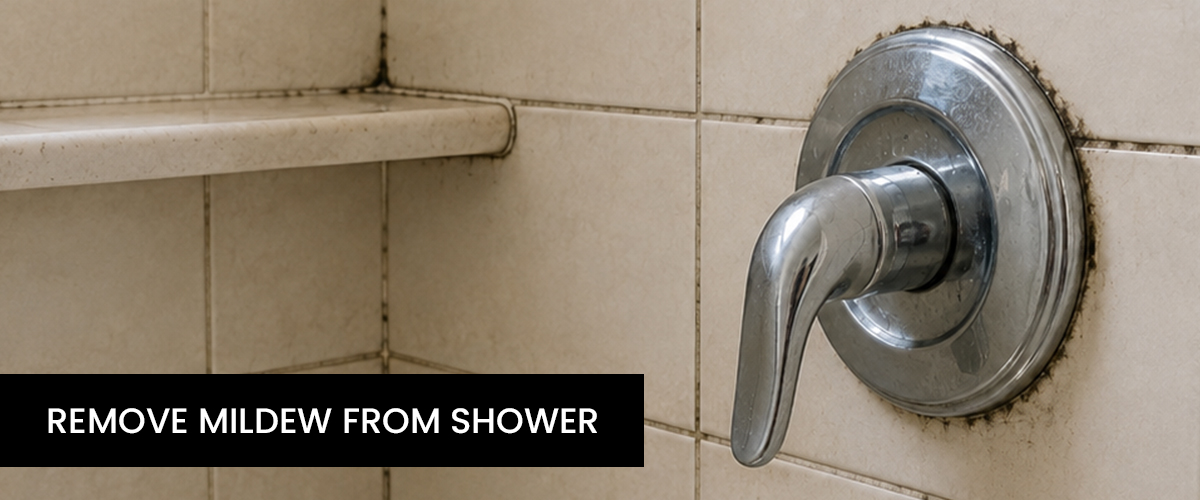
Remove Mildew From Shower
To remove mildew from a shower, ventilate the bathroom first, then apply the right product for your surface, starting with the lightest option. Mildew on non-porous surfaces like glazed tile and glass responds well to standard bathroom cleaners and vinegar. Mildew in grout lines needs a slightly stronger approach but still lighter than what mold requires.
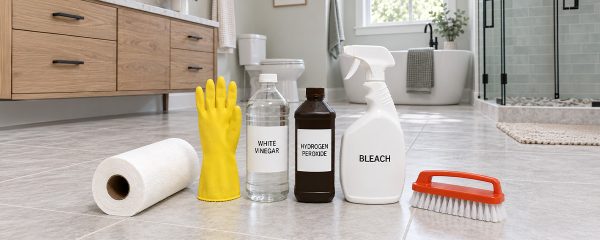
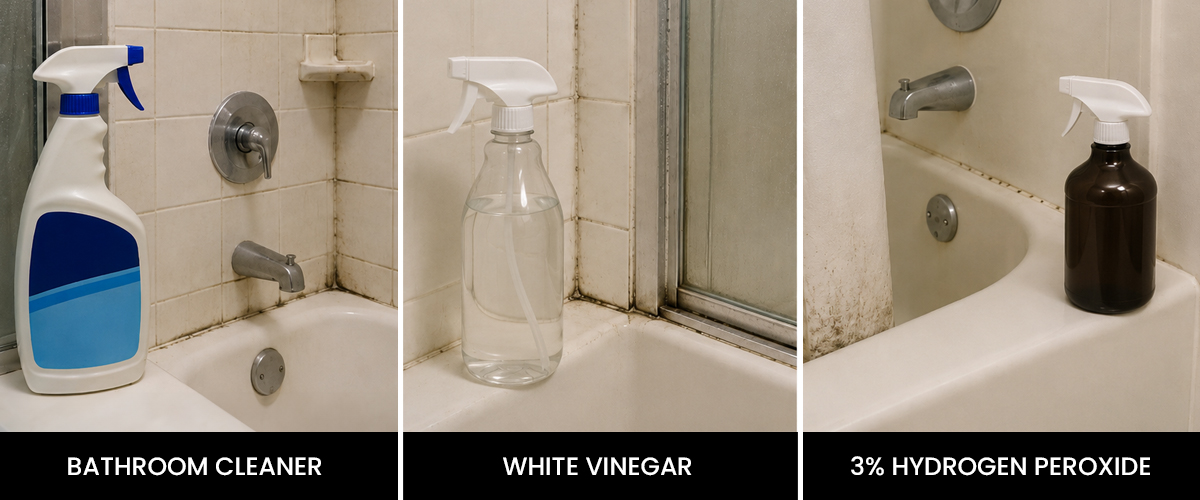
Follow this product sequence from lightest to strongest based on what you are treating:
Standard bathroom cleaner
A standard bathroom cleaner is usually the best first step for early surface mildew on non-porous surfaces like tile, glass, and fixtures.
Apply it, let it sit for 10 to 15 minutes, scrub with a soft brush, rinse well, and dry the area completely. If the mildew clears and doesn’t come back, that may be all you need.
Undiluted white vinegar
If a standard bathroom cleaner doesn’t fully remove the mildew on non-porous tile or glass, vinegar can be the next step.
Apply it undiluted, let it sit for 10 to 15 minutes, scrub the area, rinse well, and dry completely. Just keep in mind that vinegar is not an EPA-registered mold or mildew killer, so it should not be treated as a guaranteed disinfectant.
Also, avoid using vinegar regularly on cement grout. Over time, repeated acid exposure can wear down the grout binder. And never use vinegar on natural stone.
3% hydrogen peroxide
Use when mildew staining persists after the steps above, particularly near grout lines. Apply undiluted, allow 10 minutes of dwell time keeping the surface visibly wet, scrub firmly with a stiff nylon toothbrush on grout lines, rinse thoroughly, and dry completely. Do not exceed 15 minutes on colored or unsealed grout to avoid lightening.
Pro tip: After you dry the shower walls, use a light mist of daily shower spray to help slow mildew from coming back between weekly cleanings. It leaves behind a thin barrier that helps reduce residue buildup.
If you want a lower-toxicity option, look for products with the EPA Safer Choice label. Just remember, daily shower spray doesn’t replace weekly cleaning. It simply helps buy you more time before mildew becomes visible again.
⚠️ Important: Use only one cleaning product at a time. Do not combine vinegar and hydrogen peroxide in the same container or apply them to the same surface at the same time. Together, they form peracetic acid, which can irritate skin, eyes, nose, throat, and lungs.
If what you are seeing is darker, slimier, or keeps returning in the same spot within two weeks of correct cleaning and complete drying, you are likely dealing with mold rather than mildew.
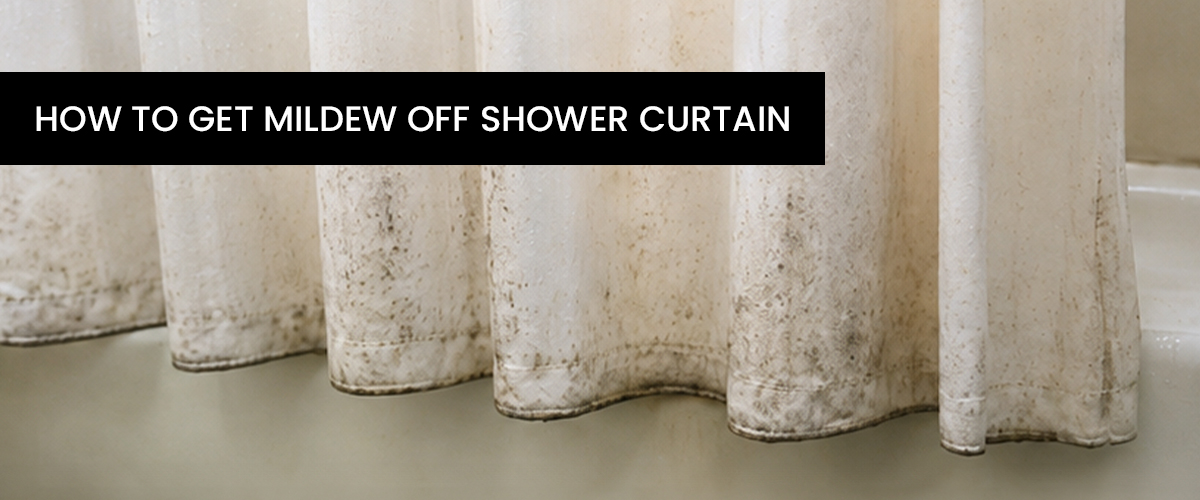
How To Get Mildew Off Shower Curtain
For mildew on shower curtains, the product sequence is lighter than what mold on curtains requires.
For plastic or vinyl liners
Undiluted white vinegar wiped onto the affected surface with a soft cloth is the lightest effective first option for surface mildew. Allow 10 to 15 minutes of contact time, wipe clean, and hang fully extended to dry immediately. For heavier mildew buildup, check the care label first. Some plastic and vinyl liners can be machine washed on a cold gentle cycle with regular detergent and vinegar in the rinse cycle. Many cannot tolerate machine washing and will warp, tear, or degrade, particularly in warm or hot water. If the care label does not confirm machine washing is safe, stick with the wipe-down method. Replace the liner when mildew returns quickly despite correct cleaning and drying habits or when the surface feels persistently slimy.
If dark growth on the plastic liner resists wiping and returns within two weeks of correct cleaning, it is likely mold rather than mildew.
For fabric curtains
Wash fabric shower curtains on the warmest setting the care label allows, using regular laundry detergent.
For light surface mildew, adding vinegar during the rinse cycle is usually enough. You don’t need a laundry disinfectant unless the mildew is heavy or keeps coming back.
After washing, hang the curtain fully extended right away so it can dry evenly. Don’t leave it bunched up while it’s still damp.
If the growth on your shower curtain is pink or orange-pink rather than gray, white, or light yellow, that is not mildew. Read our complete guide to Pink Mold in the Shower for the correct treatment approach.
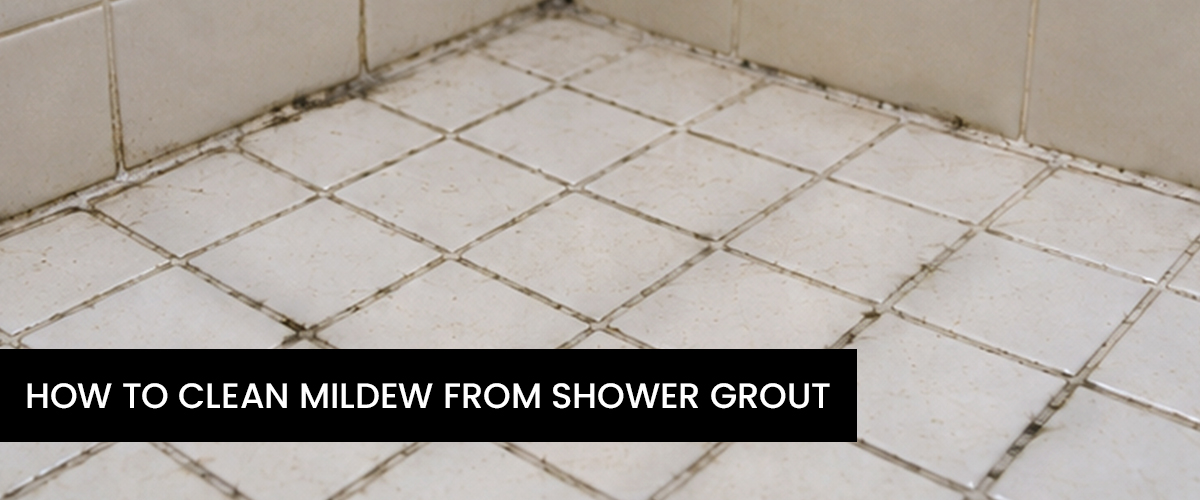
How To Clean Mildew From Shower Grout
For mildew in shower grout, start with the lightest option and escalate only if needed:
Baking soda paste
For early surface mildew in grout, baking soda paste is a good first choice. It’s mildly alkaline, doesn’t give off harsh fumes, and is gentler on grout than repeated vinegar use.
Apply the paste directly to the grout lines, then scrub with a soft scrub brush to lift the mildew and loosen buildup.
3% hydrogen peroxide
Is the next step for more stubborn mildew discoloration that baking soda does not fully resolve. Keep contact time within 10 to 15 minutes on colored or unsealed grout to avoid lightening, then rinse thoroughly and dry completely.
Borax solution (one cup per one gallon of warm water)
A borax solution can be a good option for weekly grout maintenance. Mix one cup of borax with one gallon of warm water, then apply it to the grout lines and scrub as needed.
Used regularly, it helps keep the grout surface slightly alkaline, which can slow mildew from coming back between deeper cleanings. It also does this without wearing down the grout binder the way repeated vinegar use can.
If the same grout line shows growth again within two weeks after a thorough cleaning and full drying, you may be dealing with mold rather than simple mildew.
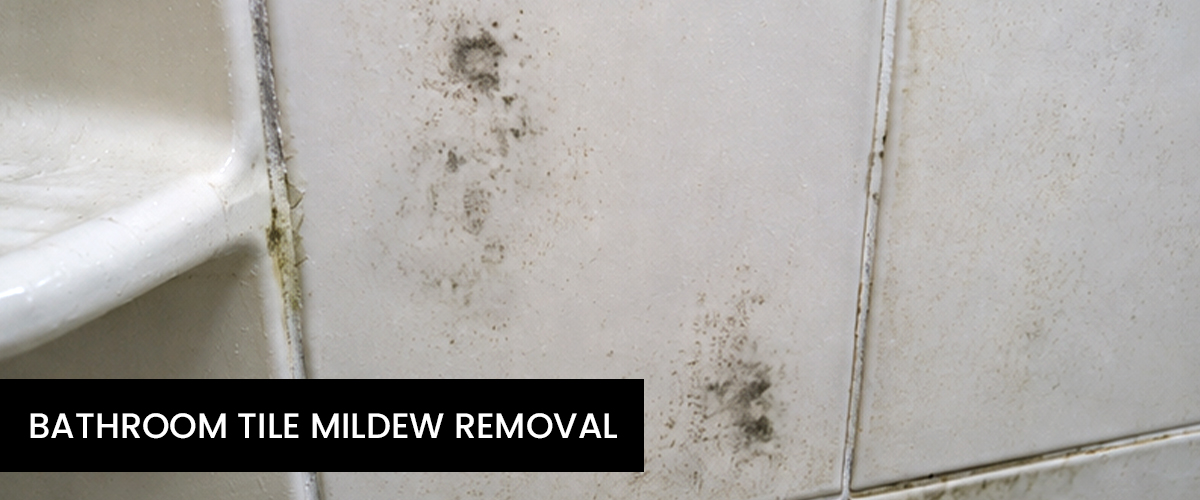
Bathroom Tile Mildew Removal
To remove mildew from bathroom tile, start with a standard non-abrasive bathroom cleaner. Spray the affected area and let it sit for the time listed on the label. For light mildew, 10 to 15 minutes is usually enough.
Then scrub gently with a non-abrasive nylon brush or soft scrub brush. Rinse the area well and dry it completely.
Avoid steel wool, abrasive pads, and hard-bristled brushes. They can scratch the tile or damage the grout.
If the mildew is still there, undiluted white vinegar can be a good next step for glazed tile.
Tile mildew is usually easier to handle than mold in grout because glazed tile doesn’t absorb moisture the same way. When mildew is caught early, it usually stays on the surface and can often be cleaned without stronger treatment.
Is Mildew On A Shower Tile Alive?
Yes. Mildew is a living fungus, not a mineral deposit or stain. Here is what that means.
Mildew is a living fungus
It belongs to the same kingdom as mold, mushrooms, and yeast. Like all living organisms, it needs food, moisture, and warmth to survive and grow. Remove any one of those conditions consistently, and you interrupt the cycle.
It feeds on what is already on your tile. Mildew does not eat tile. It feeds on the organic material sitting on the tile surface: soap scum, body oils, skin cells, and shampoo residue. That is why rinsing surfaces after every shower is one of the most effective prevention habits. Remove the food source, and mildew has less to establish on.
Mildew spreads by releasing spores
Mildew spreads by releasing tiny spores into the air. Those spores can land on damp bathroom surfaces and start growing when the moisture level is right.
That’s why mildew may show up in more than one place, even if you only noticed it in one spot at first.
Cleaning gets rid of the mildew you can see and cuts down on the spores left behind on the surface. But it won’t remove every spore floating around in the bathroom air.
To help keep mildew from coming back, focus on the conditions that let it grow: moisture, poor airflow, and leftover residue. Keep the bathroom ventilated, dry damp surfaces, and clean regularly so spores have fewer chances to settle in again.
If what you are seeing on bathroom tile is not flat and powdery but raised, slimy, or fuzzy, it is more likely mold than mildew.
Remove Mildew From Shower FAQs
What kills mildew in a shower?
Undiluted white vinegar and 3% hydrogen peroxide are the most reliable household options for reducing surface mildew on shower surfaces. Standard bathroom cleaners can help clean mildew staining on non-porous surfaces but effectiveness varies by product. Check the label for active disinfecting ingredients if killing mildew rather than just cleaning the stain is the goal. Baking soda paste is useful for scrubbing away residue and discoloration in grout lines but does not kill mildew on its own.
For all of these options, correct dwell time, firm scrubbing, thorough rinsing, and complete drying after cleaning are what determine whether the treatment actually works. Removing the moisture and residue that feeds mildew after cleaning is what prevents it from returning regardless of which product you use.
What are natural mildew removers?
The most effective natural options for surface mildew on shower surfaces are undiluted white vinegar, 3% hydrogen peroxide, baking soda paste, and borax solution. Each works differently and suits different surfaces:
Undiluted white vinegar: Effective on non-porous tile and glass for light surface mildew. Not recommended as a regular cleaner on cement grout as repeated acid exposure degrades the grout binder over time. Research has shown it has limited or no effect on some common fungal species including Aspergillus.
3% hydrogen peroxide: The strongest of the four options for surface mildew across most shower surfaces including tile, grout, and caulk. Not for natural stone.
Baking soda paste: Mildly alkaline scrubbing support for grout mildew. Does not kill mildew on its own but lifts surface discoloration and residue when scrubbed firmly with a stiff nylon toothbrush or non-abrasive scrub brush. Does not degrade the grout binder.
Borax solution (1 cup per gallon warm water): The safest option for regular grout maintenance. Does not degrade cement grout binders and leaves an alkaline surface that slows mildew regrowth between cleanings.
Does vinegar get rid of mildew in the shower?
Yes, undiluted white vinegar can help reduce surface mildew on non-porous shower surfaces like glazed tile and glass when given enough dwell time, scrubbed, and rinsed thoroughly. Let it sit for 30 to 60 minutes for visible mildew. Vinegar is not an EPA-registered mold or mildew killer, so its mildew-killing claims have not gone through EPA registration review. On cement grout, use vinegar only occasionally. Its acidity can gradually wear down cement-based grout and sealer with repeated use, making the grout more porous over time and creating better conditions for mildew to return.
Can Dawn dish soap remove mildew?
Dawn dish soap can help loosen soap scum and organic residue that mildew feeds on, but it should not be relied on to kill mildew. Used as a pre-cleaning step before applying a dedicated mildew cleaner, it can improve results by removing the residue layer first. On its own, it is not enough for mildew treatment.
What Is The Difference Between Mildew And Mold In The Shower?
Mildew stays on the surface, appears as a flat gray or white powdery film, and responds well to lighter cleaning methods when caught early. Mold penetrates porous materials like grout and caulk, appears raised, fuzzy, or slimy, and requires stronger treatment to address. Both thrive in the same damp shower conditions but behave differently and need different responses.
For a full side-by-side comparison including the wipe test, health risk differences, and how to tell them apart before you start cleaning, our guide on Mold vs. Mildew in the Shower covers every identifying characteristic in detail.
How To Prevent Mildew From Coming Back?
To prevent mildew from coming back, remove the moisture and organic residue it feeds on after every shower. Squeegee tile walls and glass immediately after use, run the exhaust fan for at least 20 minutes after showering or until mirrors and walls feel dry, rinse away soap scum and body oil residue before stepping out, and spread the shower curtain fully open to allow complete drying.
For mildew specifically in grout lines, applying borax solution during weekly cleaning maintains an alkaline surface environment that makes grout less hospitable to mildew between deep cleanings, without the grout binder degradation risk that comes with repeated vinegar use.
For the complete prevention guide covering daily habits, ventilation strategies, grout sealing, and dehumidifier use, our guide on How to Prevent Mold and Mildew in Shower covers everything in detail.
Conclusion
Mildew is usually manageable when you catch it early. Use a mild cleaner, give it enough time to work, rinse the area thoroughly, and dry it completely after each shower. Keeping up with that routine can help prevent it from coming back.
But if the same spot comes back within two weeks after proper cleaning and drying, it’s probably not mildew anymore. At that point, you may be dealing with mold that has gone deeper than the surface.
For anything that goes beyond surface mildew, our guide on [Getting Rid of Shower Mold] covers the stronger approach for every shower surface. And if you are not sure which one you are dealing with, our guide on Mold vs. Mildew in the Shower helps you tell them apart before you start cleaning.
Mildew you can usually handle yourself. Mold that keeps coming back in the same grout lines is a different problem entirely.
Mint Condition’s IICRC-certified tile and grout cleaning technicians specialize in professional tile and grout cleaning that addresses embedded growth where surface cleaning stops. Eco-friendly, family and pet safe, serving Orlando and Central Florida.
Call us at (407) 456-2035 or fill out a contact form today for your free estimate.
References
U.S. Environmental Protection Agency, A Brief Guide to Mold, Moisture, and Your Home: https://www.epa.gov/mold/brief-guide-mold-moisture-and-your-home
U.S. Environmental Protection Agency, EPA Safer Choice Program: https://www.epa.gov/saferchoice
Centers for Disease Control and Prevention, Basic Facts About Mold and Dampness: https://www.cdc.gov/mold/faqs.htm
Rogawansamy S, Gaskin S, Taylor M, Pisaniello D. An Evaluation of Antifungal Agents for the Treatment of Fungal Contamination in Indoor Air Environments. Int J Environ Res Public Health. 2015;12(6):6319-6332: https://pmc.ncbi.nlm.nih.gov/articles/PMC4483703/
Home Ventilating Institute, Bathroom Ventilation Guidelines: https://www.hvi.org/resources/publications/bathroom-ventilation/